
How to Do Keyword Research for SEO | Calgary
Keyword research is figuring out which searches your pages actually show up for, not which ones you wish they showed up for. The tools and metrics come after. First you need to know what your customers actually type, which is usually not the same thing your business calls it.
Most businesses do it once. Pull a list, write some pages, never revisit it. Then six months in they want to know why the traffic has not moved. Often the keywords were fine but the intent was wrong. Sometimes the terms had volume but the searchers were not buyers. Usually the list was built wrong, or nobody checked whether ranking for those terms would actually send useful traffic.
How to Create an SEO Report
The first real SEO report I built for a client ran to 47 pages. Covered everything: page speed scores, crawl logs, thin content flags, backlink velocity charts. The client read it, sent a one-line reply: “Which three things should I actually do?” That question became the whole framework. To-The-TOP!, an SEO agency Calgary businesses have worked with since 2007, now spends more time deciding what to cut than what to add, which is the right instinct.
SEO reporting has one job. Show what the numbers mean and what to do next. A report that documents every available metric but offers no direction is a data dump. Clients stop reading those. Once a client stops reading the report, they stop seeing value in the work itself, and that is a retainer-ending problem.
What Are Impressions on Google Ads? A Plain Definition and How to Read Them
An impression on Google Ads is one showing of your ad. Google’s own definition is that “an impression is counted each time your ad is shown on a search result page or other site on the Google Network”, and it appears in your account as the “Impr.” column. Nobody has to click, and on a typical Search campaign an impression on its own costs you nothing. What impressions tell you is how often your ad got in front of people, which is useful only once you read it alongside clicks, click-through rate and impression share.

What counts as an impression
Each time your ad appears, the count goes up by one, whether it shows at the top of a Google search, on a site in the Display Network, on YouTube or in another place where your campaign is eligible to run. Google also counts an impression when only part of the ad is shown. Its example is Google Maps, where the ad may appear as just your business name and location, or the name and the first line of your ad text. If you want to see the full list of places your Search Ads appear, it is longer than most advertisers expect.
Do Google Reviews Help SEO?
Three signals decide where a company shows up in local search: relevance, distance, and prominence. Ratings and feedback feed prominence directly. A shop with 80 fresh five-star ratings consistently outranks a competitor at the same address with 20 stale ones, all other signals being equal. Google confirmed this in its own Business Profile documentation, and the behaviour in the map pack matches the theory.
The question still comes up regularly in local SEO conversations, whether from an Abbotsford contractor chasing a competitive BC market or a Cold Lake shop competing for map visibility in a smaller Alberta one. Same answer both times. Google reviews help local SEO. Not in a vague “builds trust” way. In a measurable, repeatable way that shows up in position data month over month.
What Is PPC Campaign Management? What the Work Includes and How Often
PPC campaign management is the ongoing work of running pay-per-click advertising after the campaigns are built, so that the money spent on clicks keeps turning into calls, leads or sales at a cost the business can live with. In practice it covers seven jobs: keeping conversion tracking accurate, reviewing keywords and the searches that trigger your ads, adding negative keywords, adjusting bids and budgets, testing ads, refining targeting and landing pages, and reporting on cost per result. Setup is largely a one-off project, but management continues for as long as the ads run. Most of it happens in Google Ads, which is the focus here; Microsoft Advertising works much the same way, while paid social adds its own creative and audience work.
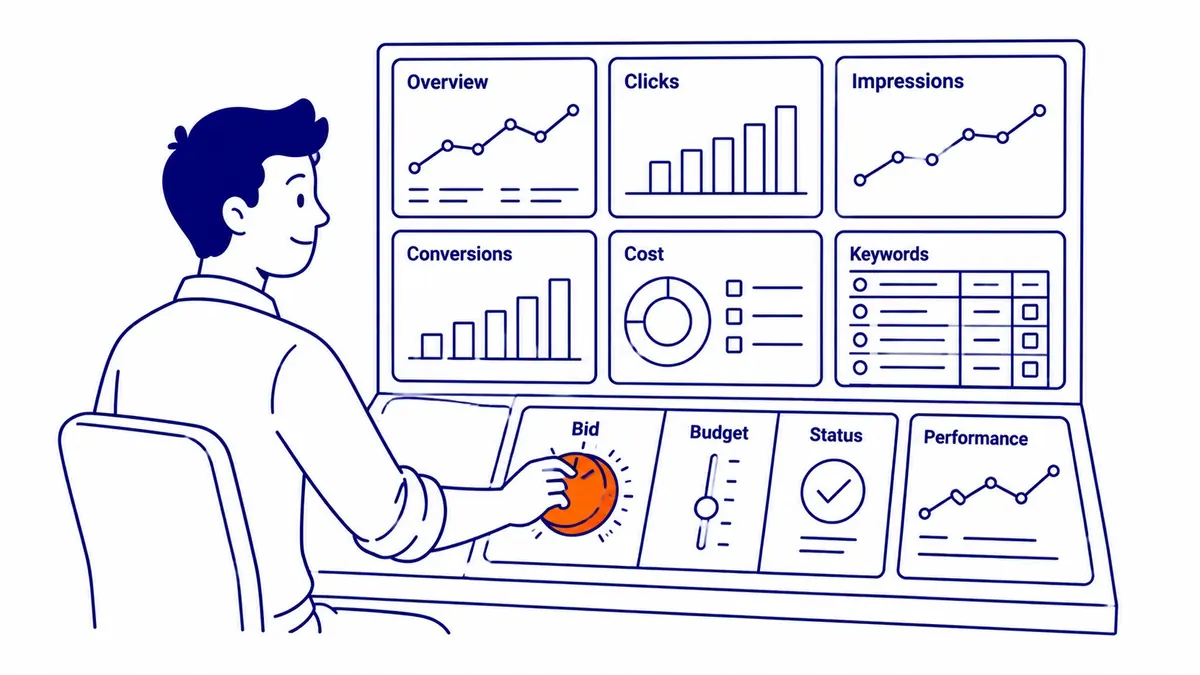
Setup and management are two different jobs
Building a campaign means choosing keywords, writing the first ads, setting a budget and a bid strategy, picking locations and connecting conversion tracking. That work is front-loaded and largely done once. Management starts the day the ads go live, because the moment real money meets real searches, the account starts producing evidence about what works, and that evidence has to be read and acted on.
What Is Video SEO?
We have seen Calgary businesses invest real money into video production, publish the result, and wonder why nothing happens in search. The video gets some views. Mostly from existing subscribers. No organic traffic. Nothing from Google.
The problem is almost never the video itself.
Is There an Age Restriction on Google Ads?
Two questions get bundled under that phrase. Who can run ads and who sees them. Both matter to advertisers running any type of campaign.
To-The-TOP! has been providing the Google Ads management Calgary businesses rely on since 2007. Age comes up often, in two ways. Some clients ask whether a teenage family member can still set up or manage the account. Others want to know whether their ads will reach people under 18. This particular question comes up often from businesses that recently hired a younger marketing assistant. Different questions, different rules.
What Are the Three Pillars of SEO? Content, Links, Technical
The three pillars of SEO are content, links and technical. That is the answer. Every version of the list names the same three, then tells you to keep all three strong.
Sound advice. This site already explains what each pillar covers, so the definitions are not repeated here. What almost nobody says out loud is stranger. The three are not three of a kind. Two of them are things you do. The third one is not.
How to Improve PPC Performance: Find the Metric That Is Failing
To improve PPC performance, first find the stage where the campaign is failing, then fix only that stage. Confirm that conversion tracking counts real leads or sales, and then read the campaign as a chain: impressions, clicks, conversions and cost per conversion. If the ads are not showing often enough, the problem is budget or Ad Rank. If they show but few people click, the problem is the keywords or the ads. If people click but do not convert, look at the landing page and the offer, and if conversions arrive at the wrong price, look at bidding and targets.
This guide from SEO Company To-The-TOP!, which has worked in Calgary search marketing since 2007, uses Google Ads for its examples, although the same diagnostic order works on other PPC platforms such as Microsoft Advertising. Each section names the columns to read, what Google’s own documentation says they mean, and the fixes that usually follow. Changing several things at once makes a campaign harder to read rather than better, so the order matters as much as the fixes.
Do Low Search Volume Keywords Affect Quality Score?
Clients who come to us for Google Ads PPC management in Calgary ask this one regularly. They spot the “low search volume” flag on a keyword. Then they worry the whole account is being dragged down. That worry is misplaced. Longer answer is worth understanding, especially if your account has accumulated dozens of these sitting idle.
Low search volume keywords are not scoring badly. They are not scoring at all. That distinction matters more than most guides take time to explain.